 EN
EN AR
AR HI
HI ES
ES FR
FR DE
DE

.jpg)
Tata Consultancy Services and MIT Sloan Mgt Review Launch New Research Series
Unveiling a Roadmap for Human-AI collaboration in Enterprises
Tata Consultancy Services (TCS) (BSE: 532540, NSE: TCS), a global leader in IT services, consulting, and business solutions, has collaborated with MIT Sloan Management Review (MIT SMR) to launch a new research series to explore the next phase of human and AI collaboration in large enterprises. As enterprises the world over are proactively investing in deploying AI-led solutions to transform their business operations, this multi-sectoral study deeply examines the new paradigms that will redefine the use of AI in global enterprise environments.
In a series of research articles covering Manufacturing, Retail and Consumer Packaged Goods, BFSI, Life Sciences and Healthcare, Energy, Resources and Utilities, and Communications, Media and Technology sectors, the study investigates how business leaders are deploying AI augmented solutions to gain a competitive edge from better decisions. The study on the theme of Human-Centric AI spans six key sectors and finds that generative and predictive AI can initiate a transformative change that drives competitive advantage. The year-long research that was conceptualized and executed jointly by MIT SMR and TCS drew insights experts and pioneers from organizations such as Walmart, Meta, MasterCard, and Pernod Ricard.
The research identifies one critical shift: AI is moving from advisor to architect. In simple terms, AI’s value shifts from improving business processes to improving the quality of options to facilitate better decision-making. Companies that master this transition are pulling ahead of those still trapped in traditional decision-making frameworks.
TCS’ industry expertise in strategizing and supporting large global organizations in their AI-led digital transformation journeys using both generative and predictive AI along with the academic rigor of MIT SMR bring forth new and fresh thinking about using AI to augment and inform Human Intelligence. The collaborative research has revealed the emergence of intelligent choice architectures — a new paradigm where human-centric AI systems proactively participate in structuring and shaping strategic decisions by generating novel options, predicting outcomes, and guiding choices.
Michael Schrage, Research fellow at MIT Sloan's Initiative on the Digital Economy and report coauthor, said,“ICAs flip the script. They do not just learn from decisions — they learn how to improve the environment in which decisions are made. That’s not analytics, that’s architecture.”
Ashok Krish, Head, AI Practice, TCS, said, “By augmenting human judgment with machine intelligence, ICAs shift AI from task automation to building superior decision environments for complex multi-factorial situations, enabling more trackable, traceable outcomes that ensure accountability. They help align talent development strategies with organizational goals, making it easier to identify and nurture high-potential employees in the AI-era. Ultimately, ICAs foster environments where human judgment and AI work together seamlessly to create connected organization intelligence, where smarter and more informed decisions are made.”
Through this new study with MIT SMR, TCS extends its long-standing commitment to understand and uncover new trends in the industry and aid partners in integrating new technologies and frameworks. Over the years, TCS has collaborated with MIT SMR on industry research about direct-to-consumer enterprises, workforce empowerment, digital inclusion, retailing, and customer experience among others. Through its partnership with MIT SMR and 50 other academic institutions, TCS curates collective intelligence that enterprises can tap into.
The sector-specific study provides compelling examples of ICAs in action to optimize choices, reallocate decision rights, and boost their bottom lines. Organizations using GenAI have helped achieve higher productivity and efficiency and cut costs while unlocking newer growth opportunities.
- In retail, AI enables retailers to both anticipate and address major challenges in turnover, customer personalization, and supply chain management. For instance, French spirit maker, Pernod Ricard, uses ICAs to test creative designs earlier in the campaign development process, enabling swift testing, refinement, and personalization of content. Walmart has found a use for ICAs in its HR department too. It uses an ICA to identify talent in local stores, expanding options for developing its internal teams.
- In manufacturing, hybrid decision-making can help create better choices in product design, supply chain optimization, and other manufacturing processes. For example, Cummins is exploring how generative AI can simulate extreme scenarios in powertrain design – demonstrating how ICAs can improve resilience and reduce time to market.
- In the BFSI sector, ICAs can help address most pressing challenges across risk management, regulatory compliance, customer experience personalization, fraud prevention, and market adaptation. For instance,Mastercard aims to connect ICAs across the onboarding, customer care, and sales functions, to unlock cross-functional insights to improve customer experience and increase operational efficiency. LibertyGPT (Liberty Mutual’s Open AI application) has helped employees save over 200,000 hours in 2024. The capability finds answers to questions and summarizes vast amounts of information.
- In communications, media and technology, AI and ICAs can help identify, evaluate, and act on more valuable opportunities. For example, British telecommunications company BT developed Aimee, an AI-driven assistant, who is part of 60,000 customer conversations weekly, handling about 50% of interactions about product or billing questions on its own and augments BT advisers on the other half. Tech major, Meta’s ICA framework allows internal teams to make data-informed product decisions faster, experiment with new business models, and optimize user engagement strategies.
- In the healthcare sector, human-centric AI can have far reaching impact on drug discovery, trials, diagnostics, and patient care. The study found that ICAs combined with scientists can transform drug research, prioritizing drug candidates with a higher probability of success, reducing time for drug discovery by 20% to 30% and lowering the related costs by 30% to 40%.
Organizations embracing ICAs do not just automate decisions, they design how they govern decision environments. Resulting decisions that are faster, smarter, more accessible, and more accountable. Both human and machine agency are clearly defined, auditable, and aligned with purpose. David Kiron, editorial director at MIT Sloan Management Review, said, “This isn’t AI as co-pilot. This is AI and humans working together as architects to redesign how people perceive, weigh, and act on choices.”
Sankaranarayanan Viswanathan, VP & Head of Business Innovation Corporate Technology Office, TCS, said,“The real challenge for enterprises isn’t just making better decisions—it is recognizing that decisions are merely the outcome of the choices they privilege or overlook. What we need are systems that foster intelligent choice architectures—enabling the organization to see, understand, and act with awareness. Accountable AI demands clarity not only in outcomes, but in the choices considered, the priorities weighed, and the trade-offs accepted. Without this, intelligent systems will silently assume decision-making authority — often without oversight or recourse.”
TCS is uniquely positioned to help enterprises navigate this new paradigm where business leaders will need to rethink policies and redesign decision making. It has been the partner of choice for numerous businesses taking the AI plunge especially when they are generally positive about the impact of AI, less certain about the path to transformation. With its suite of AI-led solutions TCS has been supporting companies across sectors seamlessly augment human insight and with algorithms. Recently, TCS enhanced its GenAI aggregator platform – WisdomNext™2.0 – with agentic capabilities. It was also recognized as the NVIDIA Rising Star Consulting Partner of the Year Award for AI Innovation and Excellence at GTC 2025.
Related Posts

The Digital Revolution from A Data-Driven Perspective
https://www.retailtouchpoints.com/resources/the-state-of-b2b-ecommerce-how-investments-in-cx-and-ai-...

Using AI to Support the Teacher
The New Role of the Teacher More than 25 years ago, I left my career as a hematologist to ent...

Asia’s leading HR technology platform Darwinbox accelerates Middle East expansion after leaping to unicorn status in latest funding round
Darwinbox, Asia’s fastest-growing HR tech platform, has leaped to a unicorn valuation in its lates...

Enthral.ai Unveils Agentic AI-based Role-Ready Solution
To empower HR and L&D leaders to build a skilled workforce ready to deliver from day one, Enthra...

AI Innovation in the UAE, AIR (AI Realtor) Launched In UAE
Unique Properties, one of the UAE’s most prominent real estate agencies, has announced a landm...

IFS Appoints Mihita Podobnik as Chief People Officer
IFS, the leading provider of Industrial AI software, today announced the appointment of Mihita Podob...
Enthral.ai Unveils Agentic AI-based Role-Ready Solution
To empower HR and L&D leaders to build a skilled workforce ready to deliver from day one, Enthra...

Shaping the Future of Work
By 2030, 70% of the skills used in most jobs are expected to change, even for people who r...
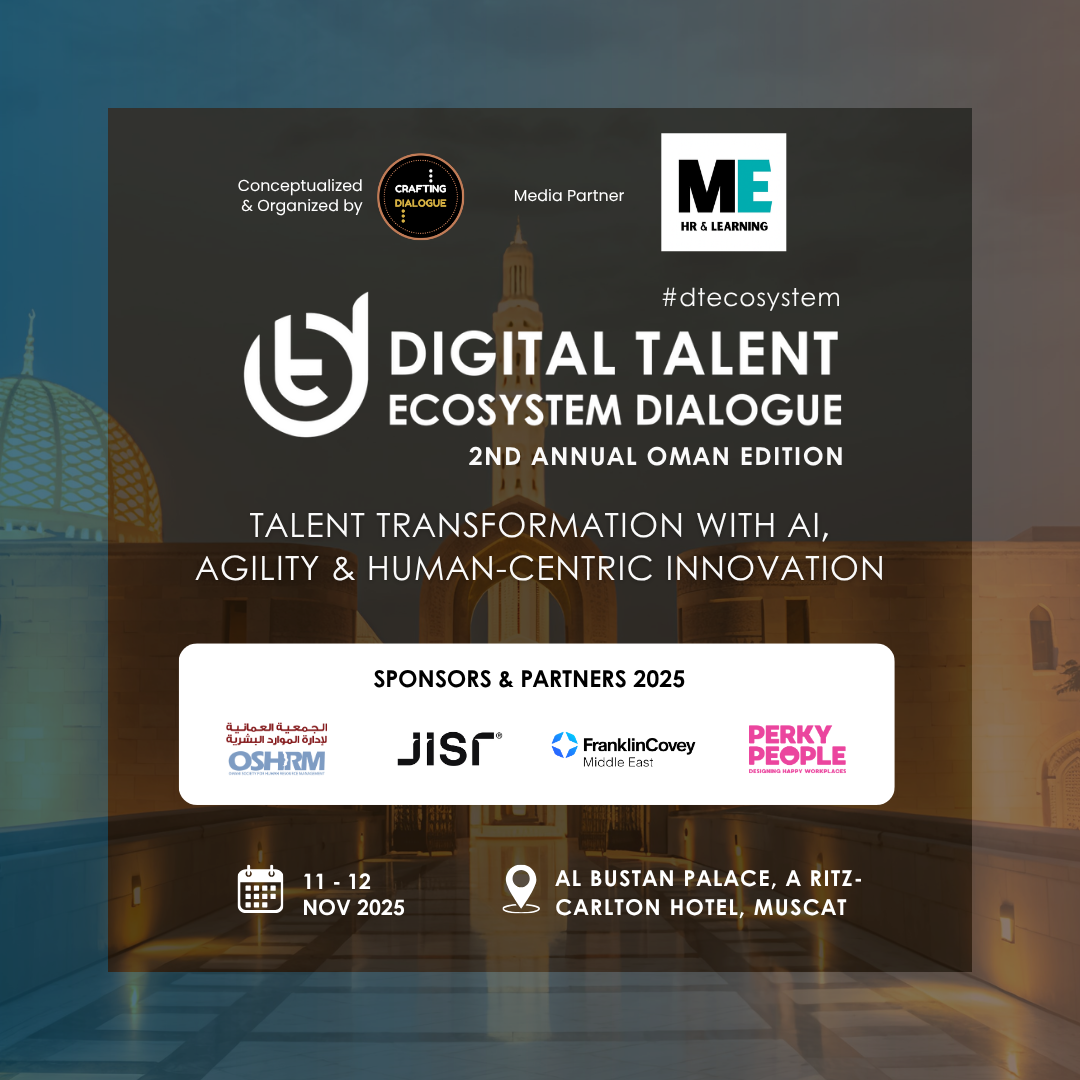
2nd Annual Digital Talent Ecosystem Dialogue, Oman Nov 2025
We're thrilled to announce our media partnership with ME-HR & Learning 2n...

Digitalization Of Motivation And Engagement As A New Turn In The HR Tech Industry In The Middle East
You've probably heard of the HR Tech industry, and anyway, if you work in it, you can feel how t...
