 EN
EN AR
AR HI
HI ES
ES FR
FR DE
DE


here are three “lenses” that I’ve found helpful in strengthening motivation, and how I use these as a coach:
- Intrinsic vs Extrinsic Motivation
- Practical vs Idealistic Motivation
- The Vital Signs of Motivation
Many of the articles I read about motivation offer fairly generic-but-good tips like, “break the task into small pieces,” or “write down your goal.” Great. But which of these practical tips apply to your specific situation?
Let’s suppose that despite my earlier advice, you’ve decided to set a New Year’s Resolution. If I were coaching you, and you told me that you were not quite sure about this commitment, I might ask you three questions:
How important is your goal?
How clear is the path to achieve this — is it doable?
To what degree do you believe that the path will work for you?
Going in the “way back machine” to Victor Vroom’s research on “expectancy theory,” these three questions reveal how likely it is that you’ll follow through on the goal. For example, if you rate each on a scale of 1-10 (where 10 is highest), and then multiply your scores, you get a total value from 1-1000. Anything over 700 is a win. You’ll quickly see that if any rating is below 7, it’s not possible to get over 700.
What’s valuable in these questions is that they don’t just tell us about a level of motivation: They usually diagnose where the challenge sits. From there, we can design a solution. There’s a guide you can download from this page which offers example strategies for each of the areas. In each area, there is an aspect where emotional intelligence is the key. For value, we need to FEEL the purpose. For practicality, we need CONFIDENCE in the steps. For self-belief, we need to TRUST ourselves. Which is hardest for you? For me it’s usually the third that’s “the real kicker” (a kind of painful-but-freeing realization).
Once you see the challenge clearly, you can look at your situation through the three lenses of motivation to craft a solution:
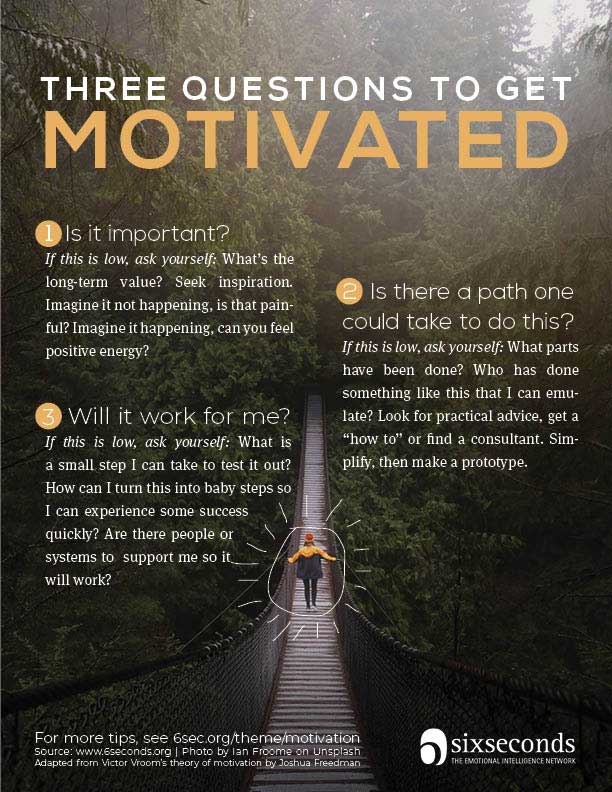 What makes motivation? Here are three powerful questions + three lenses to understand answers. The third question is the kicker: Will it work for me?
Intrinsic vs Extrinsic
Is the motivation fueled from inside or driven by external factors?
What energizes your brain, and how does this goal match that?
Are all three “pulse points” active?
Here’s a summary with more on each:
Engage Intrinsic Motivation is one of the competencies in the Six Seconds Model of Emotional Intelligence. While extrinsic forces do motivate us, they put the power in others’ hands. The word “engage” implies that the intrinsic motivators are present, we need to find a way to connect the current goal with the fire that’s burning within.
In our model of Brain Styles, one of the three scales is DRIVE; is your brain energized by the practical or idealistic? While we all probably have both, taking the Brain Brief Profile reveals your brain’s current style. If your brain is energized by the practical, then how can the current goal be translated to concrete steps? If you brain is energized by the idealistic, then how can you link the goal to long-term purpose? Discover the simple power of Brain Styles.
In our research to create The Vital Organization field guide, and the bi-annual Vitality research report (there’s one on the state of organizational vitality in the world, another coming later this year), we identified three “pulse points” that drive motivation in an organizational context. They apply to personal life as well: Meaning. Mastery. Autonomy. To increase motivation, make the goal meaningful, find aspects of it you’re great at, and create the freedom+responsibility of personal ownership. Dive into a business case on building energy with the Vital Signs of Leadership
This will be a powerful three months of turning the motivation research into practical tools. I hope you’ll join us in person and online — and I’d like to leave you with one of my favorite quotations about motivation, and a question: How are you spending your energy? Six Seconds is a community of changemakers contributing to a world of insight, connection, and purpose.