 EN
EN AR
AR HI
HI ES
ES FR
FR DE
DE


Abu Dhabi Dialogue, (ADD) at the World Government Summit, Feb 2024
Preparations for the Seventh Abu Dhabi Dialogue (ADD) Ministerial Consultation started in Dubai on Saturday, 10 February 2024, as senior officials from the ministries of labour, human resources, and employment of 16 ADD member countries held eight working sessions attended by representatives of international organisations, the private sector and civil society, as well as experts and observers.
Abu Dhabi Dialogue, which is held on the sidelines of World Government Summit 2024, is a voluntary consultative mechanism that aims to provide a public platform for dialogue on best practices between Asian labour sending and receiving countries in the Asia corridor, supporting bilateral and multilateral partnerships in the region and enhancing collaboration on labour market regulatory.
ADD also provides a platform for exchanging innovative initiatives to enhance workers’ wellbeing, ensure prosperity in the business community, and maximise benefits and advantages for ADD member countries’ economies that stem from the movement of individuals for employment within the Asia corridor.
Promoting workers’ wellbeing
The first working session, led by Professor Gibril Faal, Director of GK Partners and LSE Visiting Professor in practice, addressed the role of technology in reducing and resolving labour disputes, and the need to employ advanced technology to launch initiatives to regulate the labour market, reduce labour disputes, and reach quicker and easier solutions to settle them.
Meanwhile, the second working session featured Ahmed Alarabi, Deputy CEO of Operations & Services at the Labour Market Regulatory Authority in Bahrain, during which he discussed the importance of expanding the scope of wage protection systems in labour-receiving countries to include domestic workers. He said this falls under the role that technology plays in enhancing workers’ wellbeing, empowering countries to manage labour markets, and implementing the best available means to monitor key indicators regarding workers’ rights. The session also discussed available options for implementing technology in labour markets and its potential impact.
The third working session reviewed the need to promote safe and low-cost monetary transfers for workers from labour-sending countries, and the impact this has in terms of enhancing their wellbeing. Presented by Dilip Ratha, Lead Economist at the World Bank and Chair of the KNOMAD Thematic Group on Remittances, the session explored ways to enhance banking services and make them accessible to all categories of workers, including domestic workers.
On a related note, the fourth working session highlighted ways to use technology to improve workers’ access to health information, which effectively helps ensure their wellbeing and establish a safe work environment. Sulaiman Aldakheel, General Manager of the Gulf Health Council, spoke at the session, underlining the pioneering efforts and initiatives of the Gulf Cooperation Council countries as leading destinations for labour, and highlighting the pioneering steps the GCC has taken to enhance workers’ protection, inform them of their rights in terms of health, and educate them about health and safety standards in the work environment.
Mobility of skilled workers
Senior officials from the ministries of labour, human resources, and employment in Abu Dhabi Dialogue member countries convened in two of the working sessions and discussed ways for facilitating and enhancing skills mobility between labour sending and receiving countries in line with the future prospects of work.
The first session addressed key guidelines for building successful partnerships between countries to streamline skill transfer between sending and receiving countries, based on the evolving needs of labour markets and economic growth strategies in labour-receiving countries.
Jason Gagnon, Head of the Migration and Skills Unit at the Organisation for Economic Co-operation and Development (OECD), spoke at the session, highlighting the importance of developing the skills of workers in labour-sending countries, in line with the requirements and work environment in labour-receiving countries, in order to achieve balance and harmony between workers’ skills and labour market requirements, as well as to enhance the role that temporary workers play in accelerating economic growth and offering added value to labour-receiving markets.
Meanwhile, the second session, which featured Kishore Kumar Singh, Senior Skills Development Specialist at the Decent Work Technical Support Team of the International Labour Organisation (ILO) Regional Office for Arab States, underlined the most effective ways to match labour mobility with the needs of the labour market. The session discussed the importance of matching migrant workers’ skills and experiences with labour market requirements and future economic development goals in labour-receiving countries, in order to ensure the success and sustainability of labour mobility. This, he said, allows workers to seize the greatest possible opportunities, where they develop their skills in their home countries based on the latest requirements and modern systems adopted by labour-receiving countries.
Gender equality
Two of the working sessions included meetings to discuss ways to integrate gender equality into the framework of employment policies of Abu Dhabi Dialogue member nations. The first session examined current and potential demand for employing female workers in the field of technology, as well as ways to facilitate access to tech-related sectors to enhance women’s participation in labour markets.
The session featured Dr. Jean D’Cunha, Senior Global Advisor on International Migration, Decent Work, and Entrepreneurship at UN Women, and discussed the need to enhance women’s participation and integration in the labour market considering the major technological developments, transforming various business sectors, which have led to a significant expansion in suitable jobs for female workers, reducing the number of highly intense, which are unsuitable for women.
The second session covered ways to better evaluate women’s employment, and strategies for achieving equity and expanding women’s participation in labour markets, especially in the health sector. Speaker Tanja Dedovic, Senior Regional Thematic Specialist for Labour Mobility and Social Inclusion at the International Organisation for Migration (IOM) explained the importance of women’s participation in the labour market, the major role they play, and the vast areas where they can excel.
Activities of the Seventh Abu Dhabi Dialogue Ministerial Consultation are scheduled to officially begin on Sunday, 11 February, where ministers of labour, human resources, and employment will discuss the outcomes of the working sessions held by senior officials to review recommendations and make appropriate decisions.
The UAE hosts the Permanent Secretariat of the Abu Dhabi Dialogue, which was launched in 2008 as a forum for dialogue and cooperation between Asian labour sending and receiving countries.
Related Posts

Reduction of Two Working Hours in Ramadan for private sector employees
Ramadan officially begins when the month of Shaban, the eighth month of the Islamic (Hijri) calendar...

Fines for Domestic Recruitment Offices
The Ministry of Human Resources and Emiratisation (MoHRE) has taken legal and administrative action ...

MoHRE and International Labour Organisation Explore Opportunities to Boost UAE Labour Market Efficiency
The Ministry of Human Resources and Emiratisation (MoHRE) held a meeting with the International Labo...

MoHRE Aims to meet Zero Government Bureaucracy Targets in 2024
As part of its agenda for the “UAE Innovation Month 2024”, the Ministry of Human Resources and E...
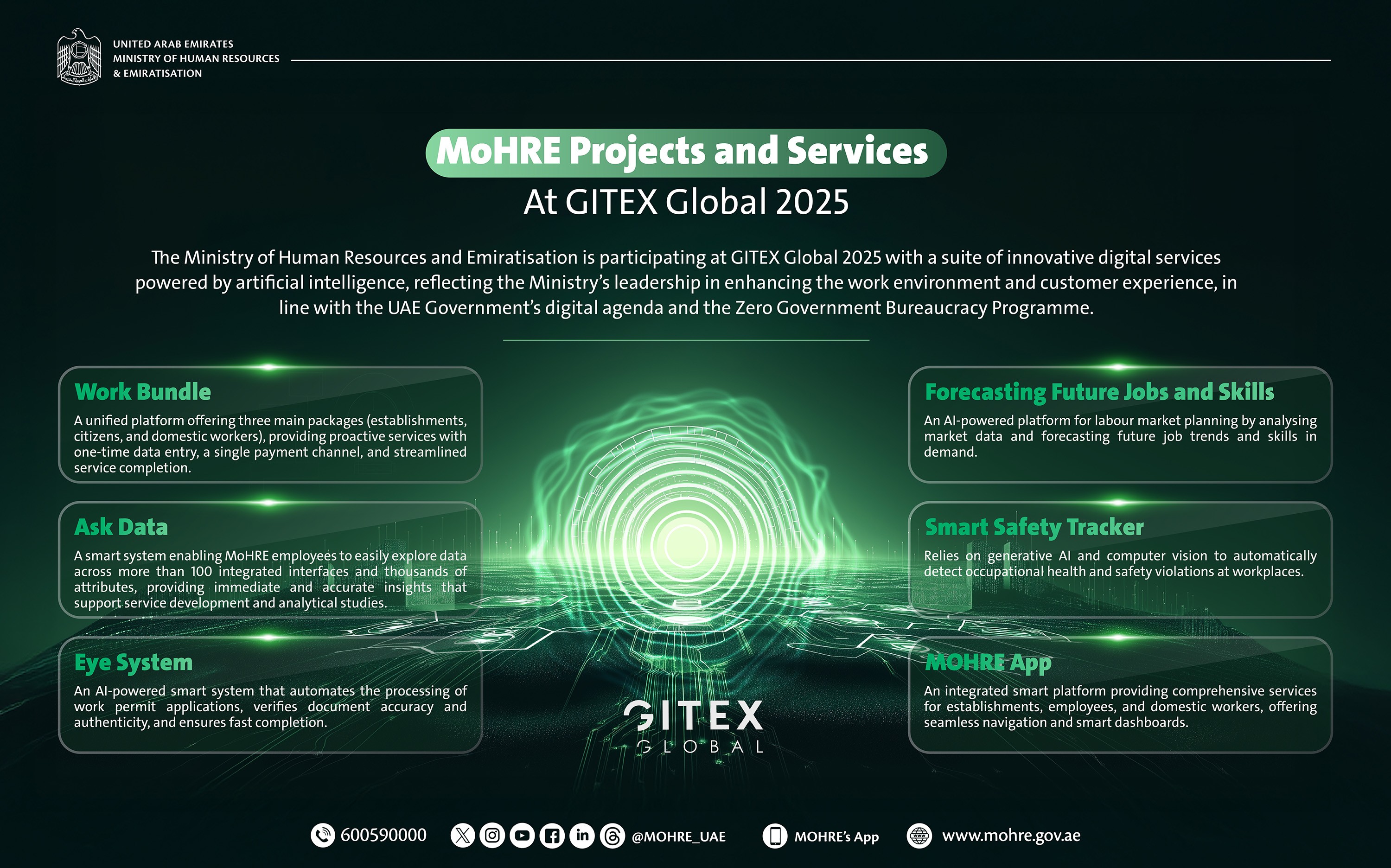
MoHRE Sets Benchmark for Digital Innovation at GITEX Global 2025
The Ministry of Human Resources and Emiratisation (MoHRE) is taking part in GITEX Global 2025, exhib...

MoHRE Showcases Digital Transformation and AI initiatives Across Its Services at GITEX Global 2024
The Ministry of Human Resources and Emiratisation (MoHRE) is showcasing a range of digital transform...

MoHRE Organises Open Career Days in 2025
The Ministry of Human Resources and Emiratisation (MoHRE) organised 50 open career days focusing on ...

Emiratisation Policies and The Nafis Programme Prove Highly Successful
The Ministry of Human Resources and Emiratisation (MoHRE) announced that the number of Emiratis work...

The United Arab Emirates Joins 13th International Labour Conference in Geneva
The United Arab Emirates joined the 113th International Labour Conference, held in Geneva, Switzerla...

UAE Showcases Its Pioneering Experiences in Advanced Technology at G20 Labour and Employment Minister Meeting in Brazil
The UAE participated in the G20 Labour and Employment Ministers’ Meeting, which concluded in F...
